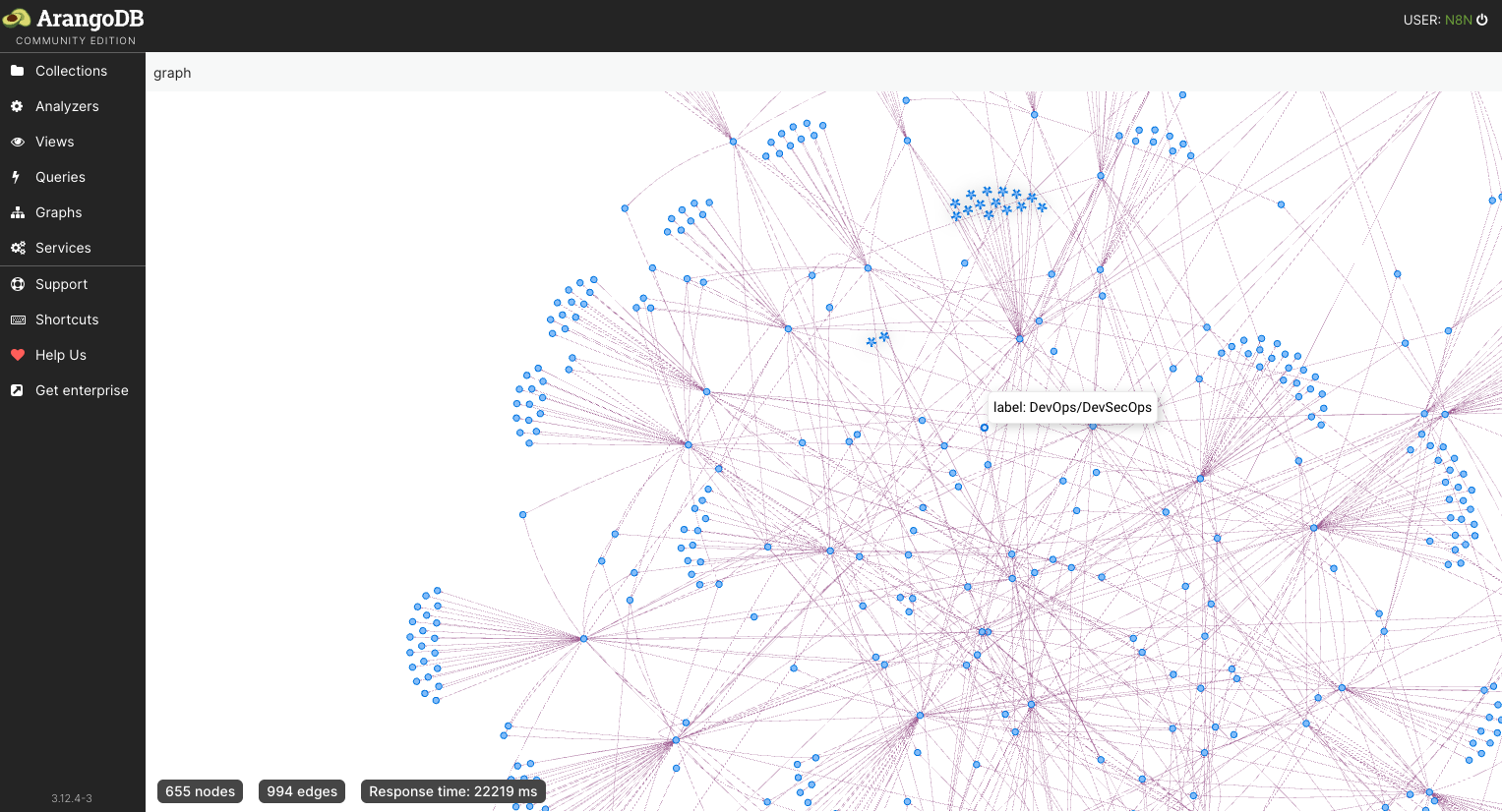
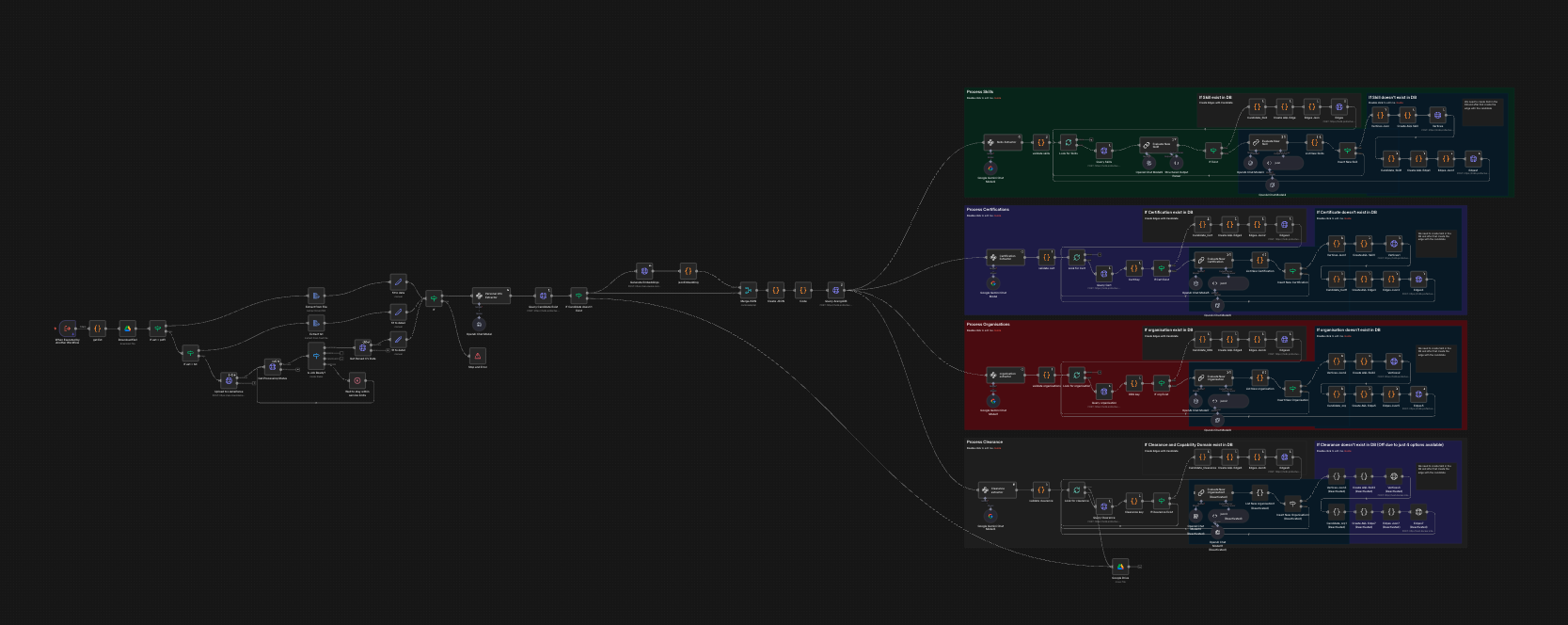
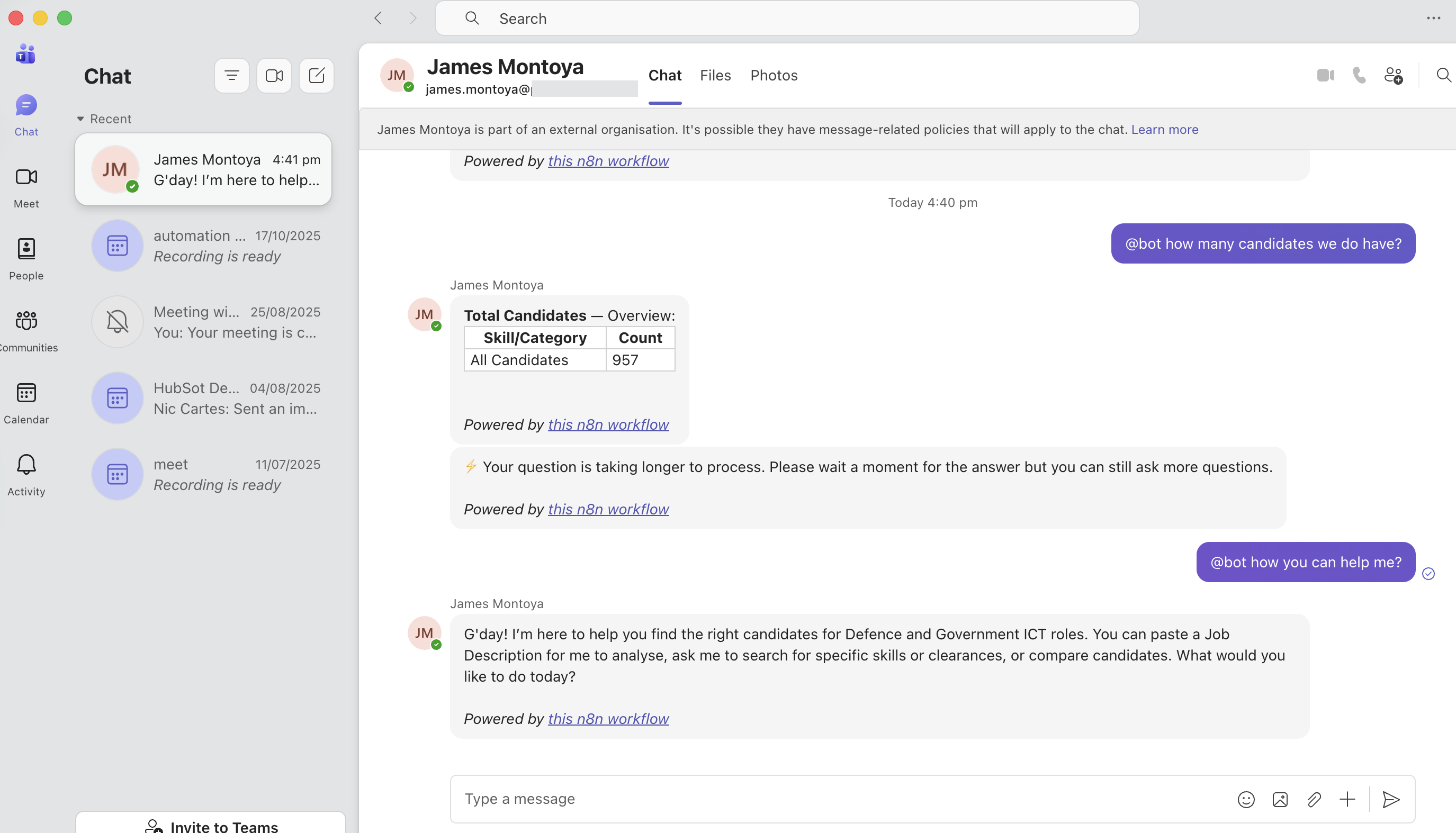
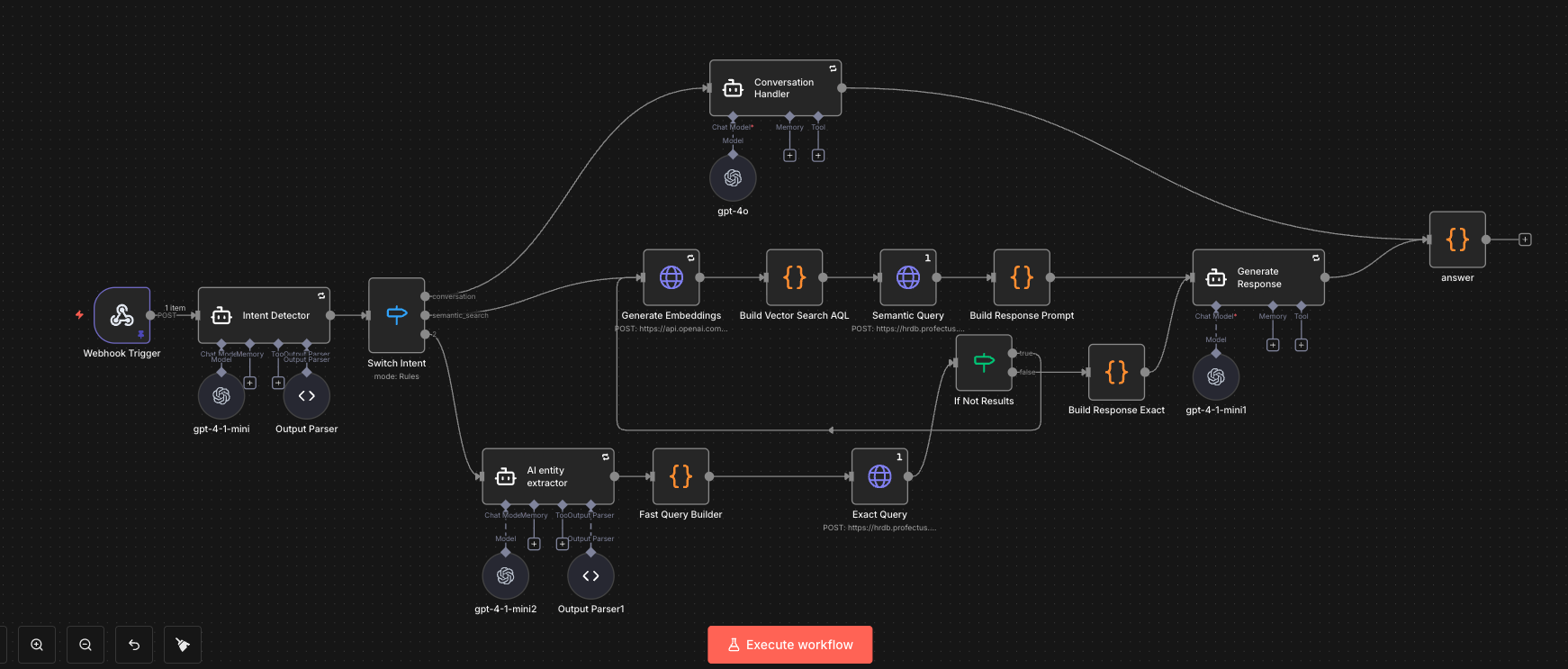
This system was built for the Australian Defence and Government recruitment sector — a domain with strict requirements around security clearances (Baseline, NV1, NV2, TSPV), government experience verification, and domain-specific skill taxonomies that standard recruitment tools simply cannot handle. The result is a production-grade, end-to-end intelligent candidate matching platform combining graph database technology, AI-powered extraction, and a dual-retrieval search engine.
Problems Solved
- CV Processing Bottleneck: Manual extraction of candidate data from CVs was time-consuming and inconsistent — recruiters spent hours on data entry instead of relationship-building.
- Search Limitations: Traditional keyword search missed qualified candidates — a "Network Engineer" search wouldn't surface an "Infrastructure Specialist" who performed identical work.
- Skill Matching False Positives: Searching for "Java" returned JavaScript developers; "SQL" matched NoSQL specialists — unacceptable in a precision-hiring context.
- No Unified Scoring: No systematic way to score candidate-to-job fit across multiple dimensions including skills, experience, clearance, location, and sector.
- Sector-Specific Requirements: Standard recruitment tools don't handle Australian Defence clearance levels, government experience verification, or domain-specific skill taxonomies.
CV Processing Pipeline
- CV Upload → Document Parsing
- AI Extraction → GPT-4.1 Mini generates structured JSON with 15+ fields (name, contact, skills, experience, clearance, certifications, etc.)
- Data Validation → Schema validation catches malformed data before insertion
- ArangoDB Graph Insertion → Candidates, skills, organisations, and clearances stored as vertices; relationships stored as edges
- Vector Embedding Generation → Dual-purpose summary optimised for both human readability and semantic search
Candidate Search Pipeline
- Recruiter Query → Router determines query type and requirements
- JD Optimiser Agent → Extracts core vs supporting skills, required clearance, location, seniority from the job description
- Deterministic AQL Query Builder (Code Node) → Constructs precise graph traversal query against ArangoDB
- In Parallel: Semantic vector search against embedded candidate profile summaries
- Merge & Score Code Node → Deterministic multi-dimensional scoring algorithm combines both result sets
- Response Formatter (LLM) → Generates readable ranked candidate summaries
- QA Validator → Multi-stage validation checks data integrity, grounding, completeness, and accuracy
- Response Delivery → Final verified output to recruiter
Weighted Multi-Dimensional Scoring (10+ Dimensions)
All scoring is deterministic JavaScript — no LLM involved in score calculation, ensuring reproducible and auditable results:
- Core Skills: 5 pts per match (cap 20) — must-have JD requirements
- Supporting Skills: 2 pts per match (cap 10) — nice-to-have qualifications
- Profile Keywords: 3 pts per keyword (cap 12) — domain alignment signals
- Role Title Match: 3 pts | Role Depth: cap 3 pts | Location Match: 3 pts
- Certifications: 3 pts per cert (cap 6)
- Defence Experience: 2 pts | Government Experience: 2 pts | Seniority: 2 pts
- Dual-match Bonus: +5 pts for candidates found by both AQL and semantic search
- Final Formula:
(AQL_score / max_score) × 60 + semantic_similarity × 40 + 5
Key Technical Innovations
Word-Boundary-Aware Skill Matching
Short skill terms (≤5 characters) use regex word-boundary matching. "Java" matches "Java" but NOT "JavaScript"; "SQL" matches "SQL" and "SQL Server" but NOT "NoSQL". This eliminated the false positives that plagued previous keyword-based approaches.
Core vs Supporting Skill Architecture
Skills are split into two tiers. Core skills form the minimum match gate — candidates must demonstrate these to rank highly. Supporting skills contribute bonus points but cannot substitute for core requirements, preventing generic profiles from outscoring domain-critical specialists.
Dual-Purpose Summary Generation
Candidate summaries are generated with a dual purpose: optimised for human readability while also including equivalent job titles, named technologies, clearance level in prose, and seniority signals — making them effective for both semantic vector retrieval and recruiter review.
Multi-Stage Pipeline Validation (4 Stages)
- Stage 1 — Data Integrity: Catches malformed data (e.g., integers where objects are expected) before it reaches the LLM
- Stage 2 — Grounding Check: Every claim in the response must be traceable to actual query results
- Stage 3 — Completeness Check: Tiered by result count — prevents count-only responses when full candidate details are required
- Stage 4 — Accuracy Check: Detects hallucinated names, fabricated contact details, or incorrectly attributed skills
The validator routes outputs to one of three paths: approve (pass through), revise (regenerate response), or pipeline_error (fix upstream data issue).
Capability Domain Classification
Candidates are classified across 13 domain taxonomies tailored to the Australian Defence and Government sector:
ServiceNow
Cyber Security & Risk
Infrastructure & Networks
Software Development
Project Management
Business Analysis
Architecture & Design
Service & Support Operations
Change & Governance
Data Analytics & AI
Procurement & Commercial
Financial Services
Administration Services
Infrastructure — Defence-in-Depth Security
- ArangoDB deployed on AWS EC2 (Ubuntu 24.04, t3.medium, 50 GiB gp3 volume)
- ArangoDB configured to listen on localhost only (127.0.0.1) — never directly internet-exposed
- Nginx reverse proxy handles all external traffic with SSL/TLS termination via Let's Encrypt with auto-renewal
- Dedicated database user with scoped permissions (principle of least privilege)
- Fail2ban for brute force protection at the OS level